Ohio State Tax Calculator
An Ohio state tax calculator shows what a salary pays once the zero-tax bracket, the single rate above it and the personal exemption are applied, then adds federal income tax, FICA and take-home pay for 2026.
Estimate your Ohio income tax
How Ohio works out income tax on a salary
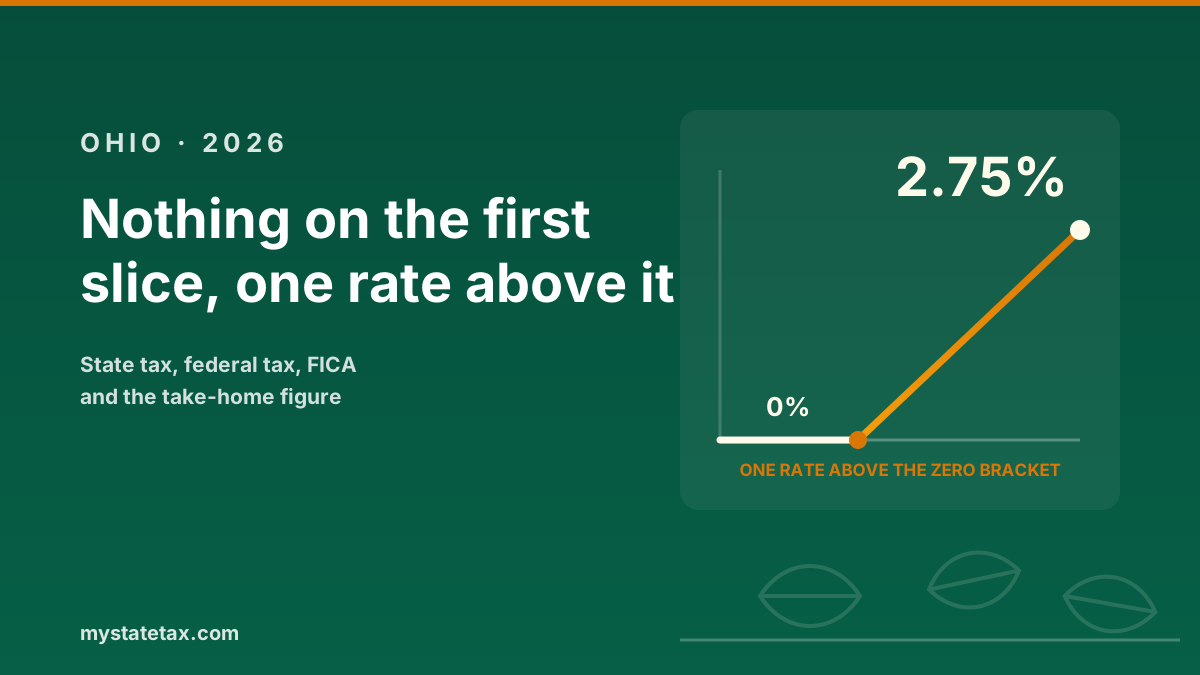
Ohio taxes wages and other nonbusiness income at a single rate, but only after a threshold that shelters the first slice of income: below it the rate is zero, above it one flat percentage. This Ohio state tax calculator applies both parts — the zero bracket and the single rate — after the exemptions allowed for the taxpayer, a spouse and each dependent.
Ohio starts from adjusted gross income and removes exemptions rather than offering a standard deduction, and because the rate does not change with filing status an Ohio income tax calculator returns the same percentage on the last dollar whether the return is single or joint. Most residents also owe a municipal income tax set by the city where they live or work, and some a school district tax on top.
Ohio tax rates for 2026 and the personal exemption
| Ohio taxable nonbusiness income | 2026 tax |
|---|---|
| $0 to $26,050 | Nothing — the rate is zero |
| Above $26,050 | $332.00 plus 2.75% of the amount over $26,050 |
| Taxable business income | 3% after the business income deduction |
| Personal exemption, per person | Amount |
|---|---|
| Modified adjusted gross income of $40,000 or less | $2,350 |
| Above $40,000 up to $80,000 | $2,100 |
| Above $80,000 | $1,850 |
| Modified adjusted gross income of $500,000 or more | No exemption |
The top rate fell to a single 2.75% line for tax years beginning in 2026, replacing the 3.125% bracket for 2025, and both the exemption and the joint filing credit switch off at $500,000 of modified adjusted gross income. The credit is the lesser of $650 or a percentage of the tax due — 20%, 15%, 10% or 5% as income rises.
How to use this calculator
- Enter the salary you will earn this year. Use the annual figure before tax — a weekly amount times 52, a biweekly amount times 26 — because Ohio applies its rate to the whole tax year.
- Set the filing status and the number of dependents. Enter 1 for Single, 2 for Married filing jointly or 3 for Head of household. Filing status does not change the Ohio rate: it changes how many exemptions belong on the return and whether the joint filing credit applies.
- Add pre-tax items excluded from federal wages. Ohio starts from adjusted gross income, so retirement contributions and health premiums withheld at work reduce the state base as well as the federal one.
- Read the state line next to the zero bracket. The breakdown shows Ohio taxable income after the exemptions, the state tax that follows from the zero bracket plus the single rate, then the federal income tax, both payroll taxes and the remainder.
Frequently asked questions
What is the Ohio state income tax rate for 2026?
Taxable nonbusiness income up to $26,050 is taxed at 0%. Above that it is $332.00 plus 2.75% of the excess — one rate, not a ladder, replacing the 3.125% bracket for 2025.
Does Ohio have a standard deduction?
No. Ohio uses a zero-tax bracket on the first $26,050 plus a personal exemption per person: $2,350 at $40,000 or less of modified adjusted gross income, $2,100 up to $80,000 and $1,850 above that.
How much Ohio state tax comes out of a $60,000 salary?
About $1,208 for a single filer claiming one exemption: the tax is $332 plus 2.75% of the $31,850 above the zero bracket, with federal income tax of about $5,020 on top.
How does an Ohio salary compare with the same pay in another state?
Run the competing salary through the calculator for that state and compare take-home figures: a new york state salary tax calculator shows what banded rates and a city tax do to the same pay.
What an Ohio salary keeps after tax in 2026
| Gross salary | Ohio income tax | Federal income tax | Social Security + Medicare | Take-home pay |
|---|---|---|---|---|
| $40,000 | $651 | $2,620 | $3,060 | $33,669 |
| $60,000 | $1,208 | $5,020 | $4,590 | $49,182 |
| $80,000 | $1,758 | $8,770 | $6,120 | $63,352 |
| $100,000 | $2,315 | $13,170 | $7,650 | $76,865 |
The rows assume a single filer claiming one exemption, the 2026 federal standard deduction and wages as the only income. The state column stays small because the first $26,050 is charged nothing and the rate above it is low: on $100,000 the Ohio tax is roughly 2.3% of salary against about 13.2% in federal income tax.
Municipal and school district taxes are not in either figure, so an Ohio paycheck calculator stops at the state and federal level; a new york state salary tax calculator covers the rest.
Sources
- IRS — Tax inflation adjustments for tax year 2026 (standard deduction and rate schedules)
- IRS — Topic no. 751, Social Security and Medicare withholding rates (6.2% and 1.45%, $184,500 wage base)
- Ohio Revised Code § 5747.02 — tax rates ($332.00 plus 2.75% over $26,050)
- Ohio Revised Code § 5747.025 — personal exemptions ($2,350 / $2,100 / $1,850; $500,000 ceiling)
- Ohio Revised Code § 5747.05 — joint filing credit (lesser of $650 or 20% / 15% / 10% / 5%)
- Ohio Department of Taxation — Annual Tax Rates (individual income tax by year)