Illinois State Tax Calculator
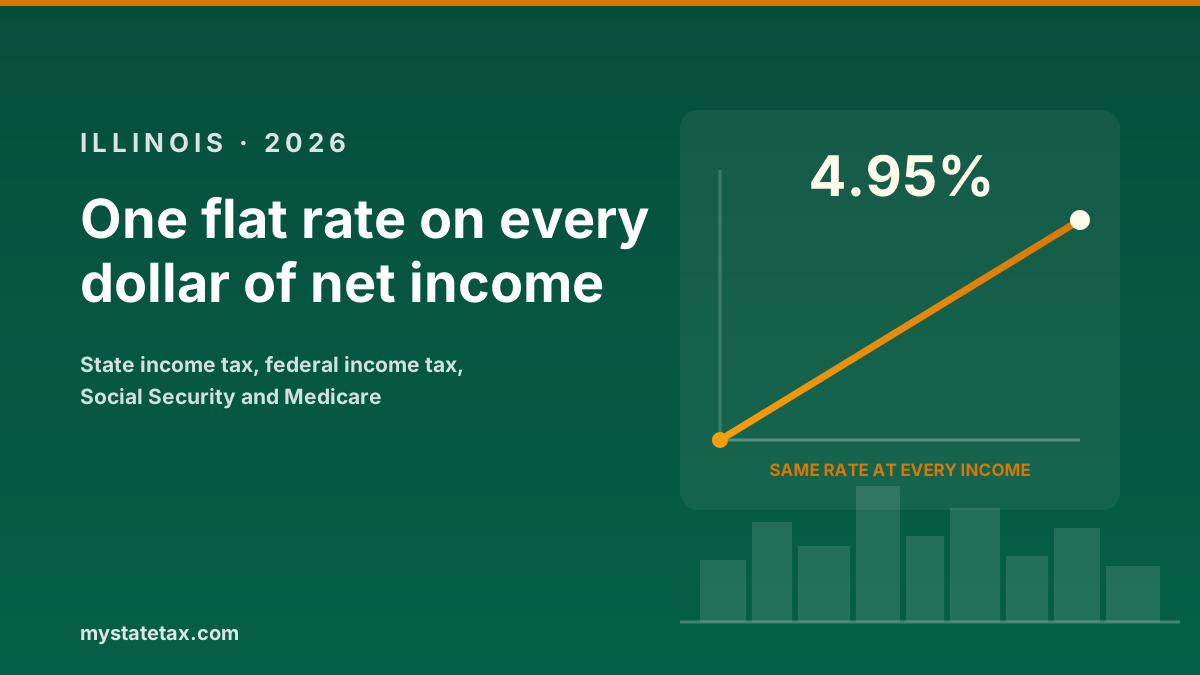
An Illinois state tax calculator turns a salary into state tax, federal income tax, FICA and take-home pay: Illinois charges one flat rate on net income and lets you claim an exemption for each person on the return.
Estimate your Illinois income tax
How Illinois works out income tax on a salary
Illinois does not run a bracket schedule for personal income: a single rate applies to net income, so the state line on a pay stub rises in a straight line with pay instead of in steps. This Illinois state tax calculator applies that rate to the salary, exemptions and pre-tax items you enter.
The base starts from the income reported on your federal return and subtracts an exemption allowance for the taxpayer, a spouse and each dependent. There is no standard deduction, so an Illinois income tax calculator applies the rate to whatever income is left.
2026 Illinois income tax rate and exemption at a glance
| Item | 2026 figure |
|---|---|
| Illinois individual income tax | 4.95 percent of net income |
| Structure | One flat rate — no brackets and no filing-status schedules |
| Standard deduction | None — Illinois uses exemption allowances instead |
| Personal exemption allowance | $2,925 for each exemption claimed |
| Exemption phase-out | Not allowed above $500,000 adjusted gross income on a joint return, or above $250,000 for all other returns |
| Withholding on wages | Employers withhold at the same flat rate |
The rate has not moved since July 1, 2017, while the exemption allowance rises to $2,925 for 2026 from $2,850 for 2025.
How to use this calculator
- Enter the salary you expect for the year. Type your pay before tax as an annual figure — multiply a weekly amount by 52 or a biweekly amount by 26, because the Illinois tax is figured on the yearly total.
- Set your filing status and the number of dependents. Filing status decides whether a spouse's exemption belongs on the return, and every exemption removes the same allowance from net income before the flat rate applies.
- Add pre-tax items already excluded from federal wages. Retirement contributions and health premiums withheld at work never reach the federal income line Illinois starts from; leave the field at 0 if none apply.
- See what an Illinois paycheck calculator leaves. The breakdown lists Illinois net income, the state tax, federal income tax, both payroll taxes and the yearly remainder.
Frequently asked questions
What is the Illinois state income tax rate for 2026?
4.95 percent of net income — one flat rate for every filer, with no brackets and no schedule that changes with filing status.
Does Illinois have a standard deduction?
No. You subtract a personal exemption allowance of $2,925 per exemption for 2026 instead, and it stops above $500,000 on a joint return or $250,000 on others.
How much Illinois tax comes out of a $75,000 salary?
About $3,568 for a single filer claiming one exemption, just under 4.8% of the salary; federal income tax on the same pay is about $7,670.
Are Social Security and Medicare part of the Illinois figure?
No. They are federal payroll taxes — 6.2% up to the $184,500 wage base and 1.45% with no wage limit.
How do I compare an Illinois salary with an offer in another state?
Compare take-home pay rather than gross: a new york state salary tax calculator shows what the same salary keeps after banded state rates.
What an Illinois salary keeps after tax in 2026
| Gross salary | Illinois income tax | Federal income tax | Social Security + Medicare | Take-home pay |
|---|---|---|---|---|
| $50,000 | $2,330 | $3,820 | $3,825 | $40,025 |
| $75,000 | $3,568 | $7,670 | $5,738 | $58,024 |
| $100,000 | $4,805 | $13,170 | $7,650 | $74,375 |
| $150,000 | $7,280 | $24,734 | $11,475 | $106,511 |
The rows assume a single filer claiming one exemption, the 2026 federal standard deduction and no other pre-tax items. Illinois tax is the flat rate applied after the $2,925 allowance, which is why it lands just under 4.8% of salary.
On $75,000 the state takes about $3,568, the federal government about $7,670 and payroll taxes about $5,738, leaving roughly $58,024.
Sources
- IRS — Tax inflation adjustments for tax year 2026 (standard deduction and rate schedules)
- IRS — Topic no. 751, Social Security and Medicare withholding rates (6.2% and 1.45%, $184,500 wage base)
- Illinois Department of Revenue — Income Tax Rates (4.95 percent of net income)
- Illinois Department of Revenue — Informational Bulletin FY 2026-15 ($2,925 personal exemption and phase-out)